|
In
September of 2007, the very last horse slaughtering plant in America, located in Illinois,
was finally shut down. As of now all horse
slaughtering facilities in the United States have been closed. This has been
a great victory, but the war is not won. Now American horses are being
hauled out of the country and sent to Canada and Mexico, and even overseas,
for slaughter. Unfortunately, these horses will be faced with
even a harsher experience. These horses will enduring longer hours in cattle
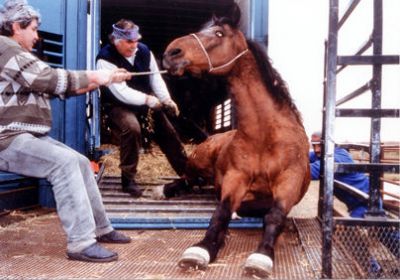
trucks and trailers with no food, water, and rest. Many collapse from
exhaustion and dehydration in these trailers. It's not unusual for horses to
be badly injured or dead when they arrive at the slaughtering plant. In Mexico there are no laws to protect the well-being of
animals before slaughter and the method of slaughtering is very cruel -the
horse is stabbed with a spike in the back of the head repeatedly until the
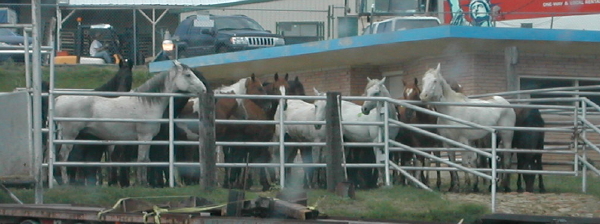
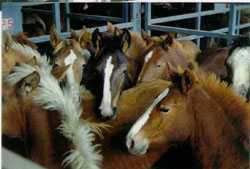
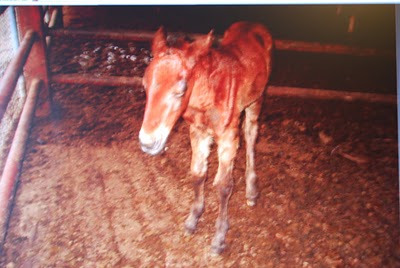
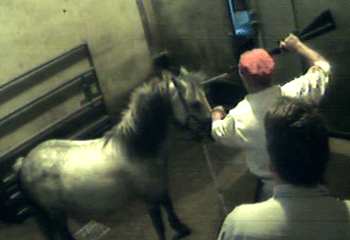
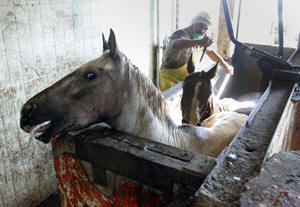
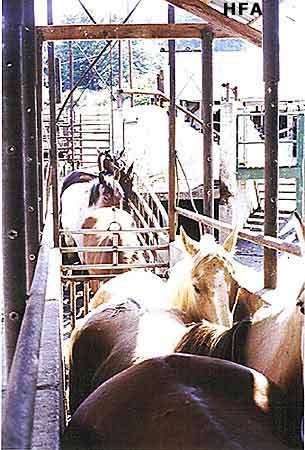
spine is severed and the horse collapses. As you know, throughout history horses have played a very important role for Man. They helped us win wars and build civilizations. They transported us and pulled our plows. Where would man be without that noble animal called the Horse. Now it's time to repay them for all the duties they've given us throughout the centuries. Horses are not livestock bred for food, but loyal companion and working animals. They are intelligent and affectionate. They are brought up around humans and pampered as valuable pets and show animals. Suddenly this pet is taken from his clean stall and shoved in a cramped trailer designed for cattle and taken to slaughter, where he is poked, prodded, and shoved in tight chutes and kicked and bit by other terrified horses to await his doom. The animal shelters are overpopulated with unwanted cats and dogs, but we don't send them to slaughter for foreign countries where dog and cat meat is consumed, so why do we not give our horses the same respect, dignity, and protection? There's a misconception that horses sent to slaughter are old crippled nags on their last leg, that is not true. Many are beautiful, healthy, fit, young horses. They range anywhere from race horses, grand prix jumpers, family pets, foals from the PMU industry, pregnant mares, stolen horses, wild mustangs, or a random unlucky horse that was purchased by a meat buyer at auction instead of rider. I have seen numerous footages of horse slaughtering and it's absolutely the most ghastly thing to watch. Unlike cattle, horses are more skittish and put up more of a fight and have to be stunned several times. Even still they are hoisted up still moving as they're being gutted. The other horses waiting to be next are hearing and smelling this horror and are panic-stricken. Also, unlike cattle, horses are not accustomed to being run down chutes and made to stand in a cramped aisle for a long period of time; this frustration causes them to kick and bit each other, so they are even more stressed and frighten. Lastly, unlike cattle, horses are accustomed to human contact and brought up to trust us, so the day at the slaughter house is very confusing and frightening for them. I'm still haunted by one image...I saw one terrified and confused horse look into the eyes of his soon-to-be-killer as if he was asking for help and to be saved from that cramped kill box, slippery with blood from the prior horse, then with no sympathy for the helpless animal, the man stun the horse repeatedly until he dropped. After the horse dropped, the man had to hang over the edge of the kill box to reach in and stun the horse 3 more times as he lay kicking. I thought to myself, "My God, that could be my horse! He was no different than my beloved horse." I want to reemphasized that a lot of these horses are young and in fair condition, but sadly they ended up in the wrong place at the wrong time. For horses, life is a game of chance. Some horse people, particularly breeders, are also to blame for this practice. There are many people who love their horses, but there is just as many who see them as a product. Like dogs, horses are over bred, either by commercial breeding farms or by backyard owners, and like dogs, breeders are just contribute to the problem of unwanted horses. As for the competitive horseman or horsewoman, they compete on their horses until they're used up and instead of selling them to a rider as a pleasure horse or retire them, most of them cast their horses away at auction or haul them to a slaughtering facility. Then they buy or breed another youngster and the process is repeated over and over again. When a horse is no longer useful, and retirement is not an option, the owner should take on the responsibility of humanely euthanizing the horse, like they would their dog or cat. Not haul it away to slaughter to get maybe $100 bucks for it. Is that a suitable reward for a horse that won his owner ribbons and prizes?
This isn't just an American issue, this a
tragic matter that is worldwide, but the fight in America is a start and
Canada is not far behind. The objective
to ban horse slaughtering and the export of horses for slaughter in North
America is a realistic possibility, but not unless citizens get involve and put the
pressure on their politicians.
Slaughtered bound horses are old, crippled, sick, injured, and can't be ridden, so why not slaughter them if they're going to die anyways? Incorrect. Although there are older and sick horses going to slaughter, the vast majority are fit and healthy. Meat buyers actually refuse horses that are too skinny or sickly for human consumption, instead those undesirable horses are sent to a processing plant to be used as a by-product. I was shocked by the reality of young and well-conditioned horses going to slaughter. What shocked me even more was that yearlings and foals were being butchered, as well as pregnant mares. Many are race horses, some of which were even Derby winners, but weren't productive enough for breeding. There are even young wild mustangs captured and sent to slaughter, paid for by our tax dollars. If a horse is old and injured, that horse deserves some dignity to be humanely euthanized after a life time of service, not butchered. Aside from a moral stand point, horses are not healthy to eat. Since horses are companion animals, they are regularly vaccinated, de-wormed, and medicated by drugs that are NOT used in livestock intended for human consumption. If the slaughtering of horses is banned, there will be an increase in abandonment, cruelty, and no place for unwanted horses to go. In 1998 the state of California banned the slaughter and import of horses for meat and there has not been an increase in abandoned or abused horses, and horse theft had actually dropped significantly. Statistics has shown that States that do slaughter horses actually have a higher rate of horse abuse and theft. As for unwanted horses, as I stated before, majority of these horses going to slaughter are young and useful, which makes them adoptable. Horse slaughtering methods are not cruel or abusive. The most common ways to slaughter a horses is by captive bolt, gunshot to the head, and a spike to the spine. Since horses have longer necks, they can move their head around better than a cow and put up more of a resistance when being stunned with the captive bolt or stabbed with a spike. Unfortunately, this results in the horse having to be stunned or stabbed several times. As for the gunshot, a horse must hold perfectly still and not move if he's to be shot directly in the brain to die instantly...if not, the horse will not die before he hits the ground but instead only suffer severe head trauma. Most horses at a slaughter facility are frighten and stressed, so they don't hold perfectly still when shot and are usually still alive and struggling when they're hoisted upside down for gutting. As for transportation, horses are crammed and jammed together in double-decker cattle trucks with the roof so low, they have to duck their heads down to avoid hitting the ceiling. They stand like this for as long as 23-36 hours without food, water, or rest. Horses aren't accustom to be in such close contact with other, so they kick and bit one another and some even collapse from exhaustion and get trampled by the others. Then they are either led in one by one into a slaughtering plant or ran down a narrow chute. Why just favor horses, what about other animals going to slaughter? Although, I believe there is a difference between companion animals (horses, dogs, and cats) and livestock (pigs, cattle, and chickens), I'm against slaughter of all animals. As I did research on the slaughtering of horses, I became aware of the brutality and inhumane treatment of farm animals. I was so shocked and disgusted by the deplorable filthy conditions the animals lived in, the way they were handled, the suffering they experience at the farm, feedlots, and slaughtering plants, I have since become a vegan. Laws are passed, but they're not enforced!! The USDA is hiding so much and are not doing their job! Since slaughter houses operate as an assembly-line (or I should say "DISASSEMBLY" line), the animals are rushed through without proper stunning procedure and therefore still conscious while getting their throats slit. The cruelty and suffering of ALL SLAUGHTER BOUND ANIMALS is despicable! Although I have given up consuming meat, if animals must be raised for food, they should be raised as comfortably and humanely as possible and their death should be quick, painless, and stress-free, but that will cost money and so it will never happen. The only way to stop the cruelty is stop eating meat and put these factory farms out of business. Along with my fight for horses, I'm also fighting for the welfare of farm animals. I urge you to learn more about factory farming and how it's not only animal abuse, but unhealthy to humans, and bad for the environment. Please visit these websites: Farm Sanctuary and Mercy For Animals. I also recommend documentaries Glass Walls, Food, Inc., Vegucated, and Forks over Knives. My final words...go vegan, if not for moral reason, at least for health reasons. What can I do to help? You can also join the fight by petitioning and contacting your State Senators or Members of Parliament to put an end to horse slaughtering.
There are horse rescue organizations that need funding to
help rescue these horses from slaughter, so donations are in need. It can be
money, a vehicle, a horse trailer, feed/hay, ranch equipment or supplies. If
you're looking to buy a horse, consider adopting a rescue horse or even
foster one. If you can't keep a horse, you can sponsor one at a horse rescue
facility or a retirement farm to help pay for his upkeep. Lastly, raise
awareness, you'd be amazed on how many people don't know this going on. The
more people that know and get involved, the more of a stir we can make and
raise some eyebrows.
Don't turn a blind eye to this matter or
leave it to others to do something. Any effort can make a difference. At the
very
least spread the word! |
 First,
I want to thank you for clicking on the link and coming here. I appreciate
your interest to learn more on this terrible issue, and I hope you will be
enlightened to get involved or at least spread the word to raise awareness.
First,
I want to thank you for clicking on the link and coming here. I appreciate
your interest to learn more on this terrible issue, and I hope you will be
enlightened to get involved or at least spread the word to raise awareness.